
On 11 Feb 1867 Samuel Carr left New York on the Henry Chauncey bound for Panama with his three children and accompanied by Mary Jane Burpee, recently employed by him as a housekeeper at the New London Hotel. His wife Eunice Keller Carr had been sent back to Boston on a trumped up errand and found them gone upon her return to New York.
The abandonment of Eunice Carr appears to have been a widely publicised event from the very beginning, both in her hometown of New London and wider afield. I have recently discovered a near-contemporary news item published only a month later on the front page of the New York Times for Sunday 17 March repeating a report from the Boston Journal. It is clearly the source for some of the later reporting from San Francisco in 1887.
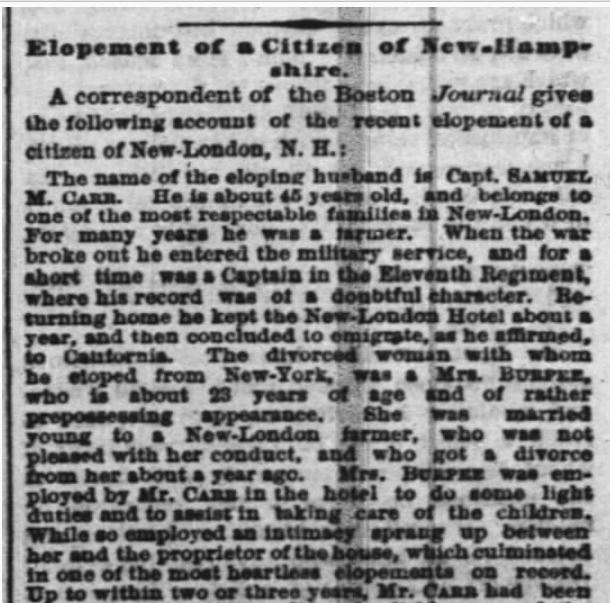
Elopement of a Citizen of New Hampshire
A correspondent of the Boston Journal gives the following account of the recent elopement of a citizen of New London, N.H.:
The name of the eloping husband Capt. SAMUEL M. CARR . He is about 45 years old and belongs to one of the most respectable families in New London. For many years he was a farmer. When the war broke out he entered the military service, and for a abort time was a Captain in the Eleventh Regiment, where his record was of a doubtful character. Returning borne he kept the New London Hotel about a year, and then concluded to emigrate, as he affirmed, to California. The divorced woman with whom he eloped from New-York, was a Mrs Burpee, who is about 23 years of age and of a rather prepossessing appearance. She was married young to a New-London farmer, who was not pleased with her conduct, and who got a divorce from her about a year ago. Mrs. Burpee was employed by Mr. Carr in the hotel to do some light duties and to assist In taking care of the children. While so employed an intimacy sprang up between her and the proprietor of the house, which culminated in one of the most heartless elopements on record. Up to within two or three years, Mr. Carr had been regarded as one of the solid and reliable men of the town, and even his suspicious intimacy with Mrs. Burpee was not universally looked upon in a criminal light. Only when he neglected and abused his own faithful wife did the New-London public believe him a thoroughly guilty man. When he left New-London with his wife and three interesting children, Mrs. Burpee rode in his team to the Potter Place. On the afternoon of that day Mr. Carr and family took the train for New-York In the meantime Mrs. Burpee took the morning train tor Grafton, where she stopped and took the return cars, actually traveling to New-York on the same train and boat with Carr and his family, and, on reaching the City, going unobserved to the same hotel. Carr sent his wife back alone to Boston, to look after imaginary lost baggage, and then went to Mrs. Burpee’s room, and took immediate measures for his hasty departure. He took a vessel for South America, which has to touch at Panama, traveling under the name of Samuel M. Carter. He bought a ticket for himself, wile, three children and baggage, for which he paid $800 in gold. The price paid for his passage is pretty sure evidence that he sailed for South America. A telegram has been sent to Panama, directing his arrest as soon the steamer the steamer touches that port. His wife journeyed alone to Boston and back to New-York, and then sorrowfully returned to the protection of her friends in New-Hampshire. Arriving in Hopkinton, where she had relatives, she found her entire worldly possessions to consist of $1 and one suit of clothes. Her guilty husband took not only her children, to whom she was fondly attached, but the greater portion of her clothing and keepsakes, together with his own property, amounting, as was supposed, to six or seven thousand dollars. As would have been expected, the intelligence created great excitement in New-London, where the injured woman had long lived. and where she is universally esteemed. Immediately after her return prominent men tendered their services to aid in the arrest of her husband while the ladles of New-London went at once to work to raise money for her present comfort and support. Several hundred dollars were subscribed by citizens to defray the expenses of the detective officers in New-York who have this matter in charge. But the crowning proof of the interest which the public take in the unfortunate affair is the fact that in the town meeting in New-London yesterday it was voted to raise $1000 to aid in the arrest, return and prosecution of SAMUEL M. CARR. His detention at Panama is considered quite probable.
Clipped from

