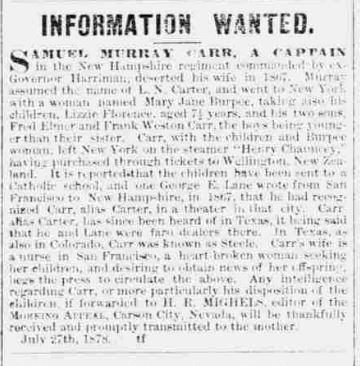
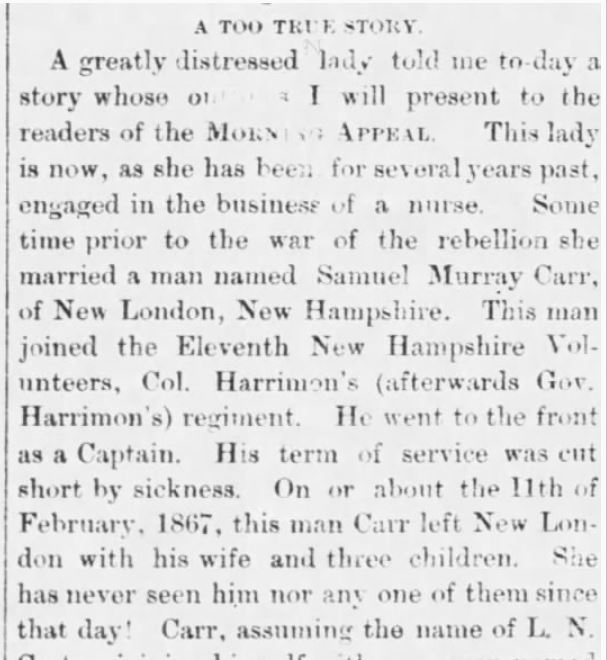
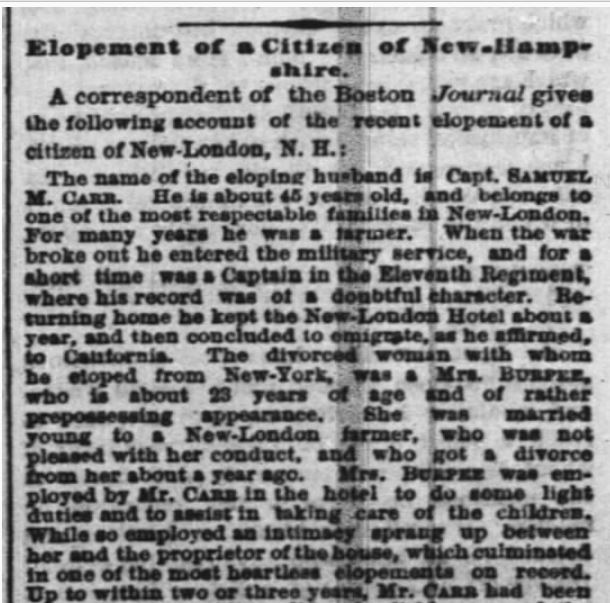
Samuel Murray Carr (aka Henry Wade Kurtain)
B: 19 Nov 1834 in New London, New Hampshire, USA
D: 21 Sep 1909 in Alameda County, California, USA
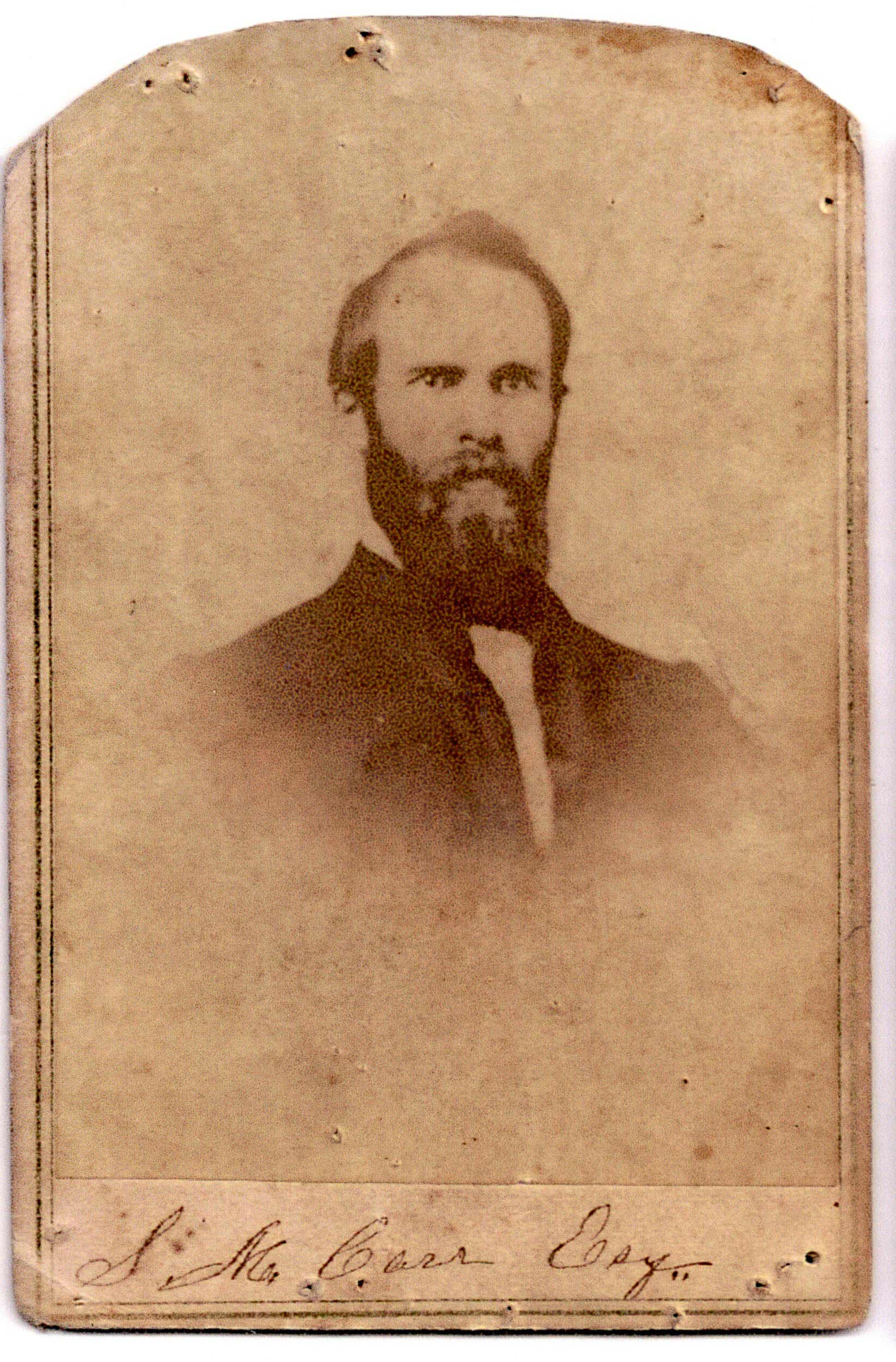
There is a mystery lying not yet fully explained in the dual identities of my Gt-Gt-Grandfather. He was born Samuel Murray Carr on 19 Nov 1834 in New London, NH, USA but was known during his time in New Zealand as Henry Wade Kurtain. He renamed his three children not only with the new surname but also with new forenames – the Carr children Lizzie Florence, Frederick Elmer and Frank Weston became known as Edner, Herbert and Edward Kurtain. Lizzie, the eldest and my Gt-Grandmother, was married under her new identity and carried her new forename of Edner for the rest of her life even after she was reconnected with her American family. Her two brothers later took back their original identities although the older brother was known on return to the US as both Fred and Herbert Carr.
For many years Carr’s reasons for taking up this alias were speculated upon in our wider family. In the myths that developed within the family there were a number of recurring common elements but there was always a hint of some kind of scandal that had needed to be concealed. Some of the versions were clearly designed to defend the reputation of the family. There are some in the family who continue to think that the explanation should remain undisclosed.
Carr’s background as a younger son of a respected New Hampshire family is known from a History of the Town of New London published in 1895. The earliest reference under the name of his father Samuel Murray Carr records his birth on 19 Nov 1834 and his marriage to Eunice Keller of Machiasport, ME. A later entry under his own name records the births of his three children, Lizzie Florance (1859), Fred Elmer (1861) and Frank Weston (1863). It also reports his enlistment as an officer in the 11th New Hampshire Volunteers during the Civil War. This unit took heavy casualties during the Battle of Fredericksberg when it was ordered into the attack across open ground against an impregnable Confederate position. The entry says that Carr was discharged disabled from the army but his military record is ambivalent. It contains a copy of his letter of resignation on account of “very important business” that made it ‘imperative’ that he should return to New Hampshire. It has been suggested that this business might have concerned his wife who was at the time expecting their third child. There is little mention of his[1] post-war career other than to say that “since 1882 Captain Carr has been a resident of San Francisco, Cal., with the Singer Machine company and is adjutant of Liberty Post, G.A.R.” [2] The history also reports that he had married a Mrs Louisa A. Sayer of Temescal, Cal on Oct 27 1895.
The remainder of Samuel Carr’s story has remained largely unknown until the recent development of digitised historical records which has made it possible to search a growing number of newspapers online.[3] Some of the previously accepted facts now need to be revised and new information on Henry Kurtain’s time in New Zealand and in the USA can be supplied to fill in some of the blanks in his story. In particular it may be possible to throw light on the mystery of why he felt the need to change his name from Samuel Murray Carr to Henry Wade Kurtain. The following is a summary of references to Henry Wade Kurtain that have been found in newspapers and official records in New Zealand during the period between his arrival in 1867 and his departure probably in 1884.
1868 Ahipara Highway District
The earliest of the Kurtain newspaper references confirm his election as a trustee of the Ahipara district in February 1868 – “the following gentlemen were elected trustees:- Mr R Duffus, Thomas Hunt, R H Matthews, Mr Walpole, and Mr Kurtain” [4] The appointment did not last long – a Provincial Government Gazette notice in the Daily Southern Cross of 11 September confirmed the appointment of “Mr Ephraim Shannon for the Ahipara district, in the room of Mr Kurtain, resigned” [5]
1869 Thames Mining Interests
The reason for his resignation may have been the attraction of mining operations in the Thames goldfield. In February 1869 Kurtain is named as one of a deputation of miners in relation to the location of a proposed stamping battery.[6] In July of the same year “Henry W Kurtain, Tararu” is named as a shareholder in the La Plata Mining Company[7] and the Little Nell Mining Company[8] at Tararu Creek, Thames. That he was a hands-on investor is demonstrated by a report from a correspondent named “Morepork” on 16 July 1869 which mentions a visit to the Little Nell claim where he was “kindly taken in tow by Mr Kurtain who has the management of that (flume) department”. [9]
In early November of 1869 Henry Wade Kurtain is named as Manager as well as a shareholder of the Tinker’s Gully Gold Mining Company and the registration application is submitted in his name. [10] Later that month he issues a notice as Manager of an extraordinary Meeting of Shareholders in the Tinkers Gully Gold Mining Company.[11]
1873 Ahipara
It is not known how long Kurtain remained in the Thames district but by July 1873 he was back in Ahipara. An article in the Daily Southern Cross reports a meeting of householders in the Ahipara District “to take measures for increasing educational facilities in the district.” The meeting was held in Mr Elder’s house and elected trustees from each of the five sub-districts. That Messrs Elder and Kurtain were both elected suggests that they lived in different sub-districts. Mr Kurtain was appointed chairman of the trustees and Mr Elder secretary. [12]
Kurtain’s time in Ahipara comes to an end in 1876. He is mentioned in the report of Mr A Buckland’s fortnightly wool sale of January 7: “H.W.Kurtain, 1 bale, H on line, half-bred, washed,13¾d, Sutherland; H.W.Kurtain, 1 bale, (over K and – under, half-bred, washed, 12d, Sutherland; H.W.Kurtain, 3 bales, – W – Under, longwool, washed, 13d, Henderson and McFarlane.”[13] But the next references are from the shipping news and record the family’s journey to the south.
On 20 October “Kurtain and family” sailed on the Iona from Russell.[14] On the 24th “The SS Hawea left Onehunga for the South” with passengers “Mr and Mrs Kurtain and 2 sons” [15] Edner was perhaps left in Auckland at this time. This is the first mention in any known record of a Mrs Kurtain or Kurtain children although children might be implied in Kurtain’s support for educational facilities in Ahipara. It has to be questioned, however, who this “Mrs Kurtain” might have been as Kurtain’s (Carr’s) wife Eunice Keller was still alive at this time in the USA.
1876 Southland
The family’s arrival in Southland is implied in the recorded arrival of their goods at the port of Bluff – 6 pkgs Kurtain per SS Wanganui on 2 November[16] and 10 pkgs Kurtain per SS Wanganui on 24 November 1876. [17] These dates are nearly a full year before the Big Land Sale of the Knapdale Run in October 1877. It seems that Kurtain was already in the district when James Elder appointed him manager of his newly-purchased properties in 1877 rather than moving there to take up the position.
Henry Kurtain was by now managing a farm in the Chatton District in Eastern Southland on behalf of James Elder. In 1880 the ownership of the Springdale property was transferred into his own name. Between 1878 and 1881 Henry Kurtain is mentioned several times in the newspapers of the district. In March 1878 he is reported as contributing to a meeting on the route to be followed by a proposed railway extension – he calls for greater consultation with residents who might be involved in ‘heavy liabilites’ as a result. [18] In January of the following year a letter is received from H.W.Kurtain by the Knapdale Road Board seeking the deferment of decision on the siting of a new bridge until after a meeting of Chatton residents to consider the matter. [19] Kurtain’s son Edward is named as 3rd placed in the Under-18 category of the 1880 Knapdale Ploughing Match with H.W.Kurtain listed as ‘Owner’, presumably of the plough and team of horses. He is reported as proposer of the toast the “Unsuccessful Competitors” at the after match dinner and also responded to another speaker “in a neat speech … on behalf of the pastoral interests.” [20]
The picture of Kurtain as a respected and public-minded member of the community is supported by a brief report in the Evening Post of 6 September 1880 that “Mr Kurtain, Chairman of the Knapdale Road Board, is spoken of as a candidate for Waikaia.” [21] The same report was carried in the Otago Daily Times and the Timaru Herald. However, the withdrawal of his candidacy was reported in the Otago Daily Times only a couple of weeks later. [22]
Mrs Kurtain receives a very warm mention in the Southland Times for being one of “two respected settlers’ wives (who) did their share handsomely in providing a little rational recreation for the young folks” in the form of an evening of dancing in the homes of “the genial hosts and their kindly spouses.” [23] Here again, although Mrs Kurtain is recognised as one of the “respected settlers’ wives” she cannot have been so in a legal sense as Kurtain’s first wife was still alive in the USA.
Kurtain continues to appear as an active member of the Eastern Southland community. At the end of 1880 he is listed as an “attending member” of the Mataura A&P Association at the annual show. [24] Early in the new year he writes as Chairman of the Knapdale Road Board complaining about the poor state of repair of a road near the Waikaka township. The Tuapeka Road Board resolves to return the letter to him with their advice that Kurtain has mistaken the boundaries and the area is not under their jurisdiction. [25] He also writes to the Southland County Council about faulty box drains in the Chatton district. [26] And on the 24th January 1881 he is reported as making submissions to the Minister of Public Works in Dunedin at the request of the inhabitants in the Otama and Chatton districts. [27] The Otago Witness also reported the interview with the comment that Kurtain had “received a favourable reply” and adding that he had been accompanied and introduced by the local member of parliament. [28]
In late February of 1881 Henry Kurtain chaired a “semi-public meeting” in Gore to discuss the establishment of a second newspaper. Three members of parliament were included in the committee elected to proceed with the proposal. That Kurtain was asked to chair such a meeting is indicative of the regard with which he was held in the district. He is not, however, without his critics. His leadership of the Knapdale Road Board is given credit by an Otago Witness correspondent for a welcome improvement in its efficiency and impartiality in tending to the residents’ roading requirements.[29] However, the reporter is taken to task in a letter from ‘Chatton’ who claims that the old Board had been unfairly criticised and that Kurtain had engineered his way onto the Board by way of a challenge to the electoral process.[30] As the to-and-fro correspondence continues it is clear that the pseudonyms are thin disguises and that the protagonists are well aware of each other’s identity. ‘Settler’ dismisses Kurtain’s character in a letter published on May 28th: “He seems in your correspondent’s eyes to be a model of perfection, but if his mode of displaying justice is in harmony with the way in which he obtained a seat at the Board, the less said about it the better.” [31]
Another contentious matter appears in the newspaper reports in the latter part of the year. It begins with a report in September that the Education Board had received “a deputation from Chatton, Messrs Milne, Donald and Kurtain, with a petition for the removal of the teacher.” [32] The Board clearly granted their request as the paper reports a couple of weeks later on a “boil over in school affairs” at Chatton. A meeting had been held to elect a chairman and secretary replacing Kurtain and two other former committee members. The new officers were commissioned to draw up a “true statement of the case and forward it to the Board, soliciting them to … retain the present teacher, such being the wish of the majority of the householders interested.”[33] The Board’s decision that the teacher would be better to resign was reluctantly accepted by the new Committee who had felt that the actions of Kurtain, Donald and Milne had been taken out of “private spite.” [34]
1881 Gisborne, Poverty Bay
As 1881 draws to a close the shipping news reports from Port Chalmers the departure of passengers “For Gisborne: Mrs Kurtain and Miss Kurtain.“ So begins the next phase of the Kurtain story. Once again the identities are not clear, in particular in respect of the “Miss Kurtain.”[35] It is possible that this was in fact Alice Burrowes, sister of the wife of Edward Kurtain, who had been taken into Mrs Kurtain’s care. It was previously thought that Kurtain had returned to the USA about 1882. However, it now appears that he spent some time in Poverty Bay before his final departure from New Zealand and return to California probably in 1884.
The first reference to Henry Kurtain in the Poverty Bay Herald displays him in March of 1882 already taking a familiar role as chairman of a public event. The occasion is the farewell to the Rev J Dellow of the Wesleyan Chapel during which “a public meeting was held, Mr Kurtain being in the chair.” [36] To be cast in such a prominent role so soon after his arrival in the district speaks much for the confidence Kurtain was able to engender in those around him. He must have performed the task well for he is called into a similar role at the annual soiree of the Wesleyan Church a few months later [37] as well as for the farewell to Rev L. Hudson in the following year. [38] On all three of these occasions Mrs Kurtain and Miss Kurtain are listed among the ladies and girls who decorated the venue and served refreshments to the substantial number of attendees.
The close association of the Kurtains with the Wesleyan Church and the high regard in which Mrs Kurtain in particular was held are evident in this paid notice placed in the Poverty Bay Herald of 26 April 1883:
“THE following resolutions were passed at a meeting of the Ladies’ Sewing Bee, held in the Wesleyan Church, on. April 25th, the Circuit Minister being in. the Chair “This meeting having heard with deep regret that a certain person has, by his late actions, been casting reflections upon the character of one of its members, desires to express its entire confidence in Mrs Kurtain, and the manner in which she has discharged her duties as treasurer of our society, and requests her to accept our hearty thanks for past services and That the above resolution be inserted in the daily paper.” (Signed) HANNAH HACCHE, President.[39]
The concern of the church ladies for their friend’s reputation is very clear as is their determination that the intent of their resolution should reach a public audience. It is tempting to speculate on whether the “certain person” they refer to might have been Kurtain himself.
Perhaps not, however, as Henry Kurtain’s acceptance as a respectable member of Gisborne society continues to be reflected in the pages of the Poverty Bay Herald. In May 1883 he is listed as one of the ‘gentlemen’ present at a reception for the Governor Sir William Jervois who was making an official visit to the district. Listed alongside his are the names of many prominent settlers whose names are known in the town to this day – Sieveright, Chrisp, Bull, Crawford, Ferris, Williams, DeLautour, Nolan, Haache. [40] In the same month Kurtain was called to jury service in an assault case tried in the first-ever sitting of the Supreme Court in Gisborne. [41] In July of the same year Kurtain is reported as one of a small working committee charged with establishing a local branch of the Amalgamated Society of Carpenters and Joiners which may give an indication of his occupation at the time. [42]
In July 1883 Henry Kurtain was reported as re-elected to the Committee of the Turanganui Library on which he had already served for the previous year.[43] He must have been first elected only a few months after his arrival in the district. The committee would have been a very active one for they were constructing a new building and were planning a week-long Fine Arts Exhibition to commence on the 22nd October in connection with the opening. Kurtain was named as one of the Executive Committee for the exhibition [44] and public notices advertising the exhibition listed him as one of the members from whom tickets could be obtained. [45]
Kurtain’s occupation as a storeman at Messrs Common, Shelton & Co is mentioned in a report of an accident which befell him on his way home from work one evening in August 1882. While taking a short-cut in the dark he fell down an unused well behind the Borough Council building. He was able to extricate himself and make his way to his home in Gladstone Road where the doctor diagnosed a couple of broken ribs.[46] It may have been the experience gained in this position that led him early in 1884 to open a General Store “up the road, at the corner of Disraeli Street (and Gladstone Road).”[47] It is probable that he lived on the premises. He may have been trading on his own account prior to this as a shipping note in June 1883 records a shipment from Port Chalmers to Gisborne of “157 sacks oats H. Kurtain” – it is tempting to think they may have been consigned from the Chatton farm as a similar shipment of 84 sacks left Bluff for Port Chalmers in November in the Kurtain name.[48] In any event, a series of notices dating from 14 January 1884 announce the opening of the store and advertise the items on sale – “a selection of most CHOICE TEAS, GROCERIES, DRAPERY, CLOTHING, PAINTS, OILS, IRONMONGERY, BOOTS, SADDLERY, TENTS, TARPAULINS, CORDIALS, PATENT MEDICINES, FOWL FEED, MAIZE, whole and crashed.”[49]
The venture was short-lived. On the 18th February, although the store advertisements still ran (presumably pre-paid) until the 6th March, Kurtain was advertising “TO LET: A STORE in Gladstone Road, with nearly 12 years lease to run; with or without stock” [50] There were no takers. On 28 February the auctioneers Graham, Pitt & Bennet advertise the mortgagee sale of “All the goods, stock-in-trade, fixtures and chattels now being upon those premises corner of Gladstone Road and Disraeli Street, lately in the occupation of HENRY WADE KURTAIN, and also, All the unexpired Residue of a Term of Lease of 12 years (having nearly the whole of the term to run), of Part Section 303 and Part Sectioon 304, Gisborne, containining (sic) by admeasurement 34 perches, more or less, and lately in the occupation of HENRY WADE KURTAIN.” [51]
The imminent collapse of the business must have been obvious as the shipping news for 16 February records the departure of Mrs Kurtain and family: “DEPARTURES. Februarv. 16 – S.S. Rotomahana, for South. Passengers – Mesdames Kurtain, Palmer, and Hobarts; Misses Kurtain, Booth, and Keenan; Messrs.Westrupp, Cassin, and Redmond; Masters Burgess and Kurtain, and two natives.” [52] It will be noted that the mysterious “Miss Kurtain” has been joined by a previously unmentioned “Master Kurtain.” Kurtain himself followed soon afterwards although travelling in the opposite direction – “Wairarapa SS. For the North” – on the 3rd of March 1884. [53] His resignation from the committee and the fact that he had left the district are reported in July in the annual report of the Turanganui Library. [54]
So draws to a close the Gisborne chapter of Henry Wade Kurtain’s time in New Zealand.
[1] p227 “A History of the Town of New London, Merrimack NH”, Myra B Lord (1899 New Hampshire Publishing Co, Somerton)
[2] p451 “A History of the Town of New London, Merrimack NH”, Myra B Lord (1899 New Hampshire Publishing Co, Somerton)
[3] For New Zealand papers see the Papers Past website of the National Library in Wellington: http://paperspast.natlib.govt.nz
[4] New Zealand Herald, Volume V, Issue 1324, 13 February 1868, Page 4 – reported also in the Daily Southern Cross of the same date.
[5] PROVINCIAL GOVERNMENT GAZETTE Daily Southern Cross, Volume XXIV, Issue 3481, 11 September 1868, Page 3
[6] New Zealand Herald, Volume VI, Issue 1644, 27 February 1869, Page 5
[7] Daily Southern Cross, Volume XXV, Issue 3736, 9 July 1869, Page 2
[8] New Zealand Herald, Volume VI, Issue 1759, 12 July 1869, Page 2
[9] New Zealand Herald, Volume VI, Issue 1763, 16 July 1869, Page 5
[10] Daily Southern Cross, Volume XXV, Issue 3808, 2 November 1869, Page 5
[11] Daily Southern Cross, Volume XXV, Issue 3824, 20 November 1869, Page 1
[12] Daily Southern Cross, Volume XXIX, Issue 4969, 28 July 1873, Page 2
[13] New Zealand Herald, Volume XIII, Issue 4422, 15 January 1876, Page 6
[14] Auckland Star, Volume VII, Issue 2090, 20 October 1876, Page 3
[15] Auckland Star, Volume VII, Issue 2092, 24 October 1876, Page 2
[16] Southland Times , Issue 2585, 3 November 1876, Page 2
[17] Southland Times , Issue 2606, 24 November 1876, Page 2
[18] Otago Witness , Issue 1371, 9 March 1878, Page 10
[19] Bruce Herald, Volume XI, Issue 1077, 10 January 1879, Page 3
[20] Otago Witness , Issue 1498, 31 July 1880, Page 22
[21] Evening Post, Volume XX, Issue 208, 6 September 1880, Page 3
[22] Otago Daily Times , Issue 5799, 20 September 1880, Page 2
[23] Southland Times , Issue 3817, 14 September 1880, Page 2
[24] Southland Times , Issue 3884, 1 December 1880, Page 2
[25] Tuapeka Times, Volume XIII, Issue 702, 15 January 1881, Page 2
[26] Southland Times , Issue 3922, 17 January 1881, Page 2
[27] Southland Times , Issue 3928, 24 January 1881, Page 2
[28] Otago Witness , Issue 1525, 29 January 1881, Page 18
[29] Otago Witness , Issue 1534, 2 April 1881, Page 13
[30] Otago Witness , Issue 1537, 23 April 1881, Page 13
[31] Otago Witness , Issue 1542, 28 May 1881, Page 12
[32] Southland Times , Issue 4113, 5 September 1881, Page 3
[33] Southland Times , Issue 4133, 28 September 1881, Page 2
[34] Southland Times , Issue 4163, 2 November 1881, Page 2
[35] New Zealand Herald, Volume XVIII, Issue 6247, 24 November 1881, Page 4
[36] Poverty Bay Herald, Volume IX, Issue 1580, 30 March 1882, Page 2
[37] Poverty Bay Herald, Volume IX, Issue 1708, 30 August 1882, Page 2
[38] Poverty Bay Herald, Volume X, Issue 1875, 21 March 1883, Page 2
[39] Poverty Bay Herald, Volume X, Issue 1905, 26 April 1883, Page 2
[40] Poverty Bay Herald, Volume X, Issue 1932, 29 May 1883, Page 2
[41] Poverty Bay Herald, Volume X, Issue 1951, 20 June 1883, Page 2
[42] Poverty Bay Herald, Volume X, Issue 1985, 30 July 1883, Page 2
[43] Poverty Bay Herald, Volume X, Issue 1967, 9 July 1883, Page 2
[44] Poverty Bay Herald, Volume X, Issue 2033, 4 October 1883, Page 2
[45] Poverty Bay Herald, Volume X, Issue 2013, 18 October 1883, Page 3
[46] Poverty Bay Herald, Volume IX, Issue 1687, 5 August 1882, Page 2
[47] Poverty Bay Herald, Volume XI, Issue 2082, 12 January 1884, Page 2
[48] Southland Times , Issue 4784, 6 November 1883, Page 2
[49] Poverty Bay Herald, Volume XI, Issue 2083, 14 January 1884, Page 3
[50] Poverty Bay Herald, Volume XI, Issue 3013, 18 February 1884, Page 2
[51] Poverty Bay Herald, Volume XI, Issue 3022, 28 February 1884, Page 3
[52] Poverty Bay Herald, Volume XI, Issue 3012, 16 February 1884, Page 2
[53] Poverty Bay Herald, Volume XI, Issue 3025, 3 March 1884, Page 2
[54] Poverty Bay Herald, Volume XI, Issue 4035, 11 July 1884, Page 2